

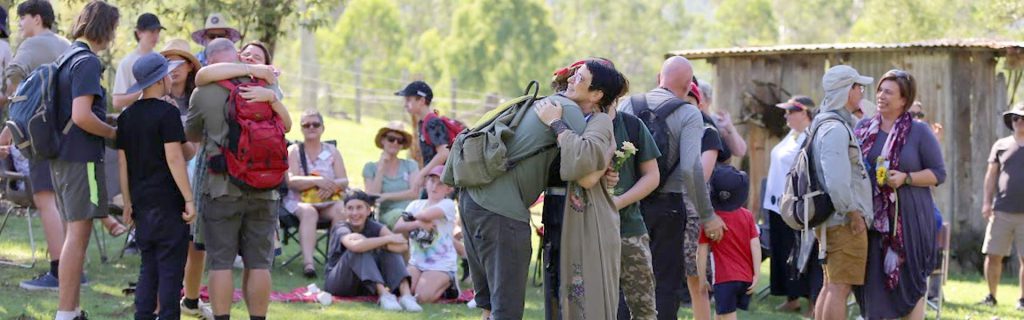
The “Journey to Manhood”—J2M—isn’t just a campout. It’s a rite of passage. Boys between 13 and 17, and their dads, stepping off the map and into the wild. Mums? They’re essential—heart and backbone of the whole setup. But the deep magic unfolds over five raw, unforgettable days at The Rock.
Just fathers and sons, completely off-grid— alone with the bush, the fire, and whatever truths rise up from the silence.
No phones. No screens. No distractions. No escape from what actually matters.
Just blokes finding each other in the spaces between words, in shared silence, in the glow of firelight and the quiet courage it takes to be real. The kind of weekend that makes you wonder why this stuff isn’t done more often? Why we settled for shallow connections when the deep ones are waiting just beyond our comfort zones all along.
Mothers stay behind, their goodbye hugs reluctant to let go. Arms lingering, eyes speaking what words can’t carry.
The boys arrive— shoulders hunched, jokes too loud, fidgeting under the quiet pressure of becoming something they don’t yet understand.
The fathers— stoic, silent, gripping their expectations like shields, as if manhood could be passed down like a family heirloom.
But out here, at The Rock, none of that holds. The bush has its own language. And before long, even the bravest masks begin to melt in the firelight.
The venue provides the background for magic. Welcome to the wilderness.
Then comes the parting—not loud, not grand, but quietly seismic. The boys are simply told, we’re going on a silent walk. No clue where, no clue how long. Just the knowing that something is beginning, and the weight of a backpack pressed between their shoulder blades. We set off together—staff flanking the group, myself among them—like shadows dissolving into the morning mist.
We pass through wide cow paddocks softened by days of rain, the earth still spongey beneath our boots. The grass clings to ankles, dew-soaked and stubborn. There’s the occasional startled bird, a half-watched sky, a fence to duck beneath. The ground rises and dips without explanation. A creek crosses our path and so we cross with it—stepping stones or wet socks, depending on luck. No one complains. No one speaks. The silence is not empty, but full—stretched tight like the sky before a storm, humming with things unspoken.
The boys don’t know it yet, but they’ve already begun to cross. Not just fences and fields, but a deeper threshold—into the unknown, into themselves. Their steps, cautious at first, begin to settle into rhythm. Uncertainty softens into surrender. This isn’t just a walk. It’s something else. A passage.
Something ancient stirs beneath our feet. The land watching, quiet and old, as these young ones move not toward a destination, but a transformation.
Meanwhile, the fathers are driven the other way—back down the track, away from the sons they can no longer shield in the old, familiar ways. Their backs sit stiff in the seats, their hands searching for something solid—armrests, coffee cups, anything to keep them from unraveling.
The cars are filled with a silence that isn’t peaceful. It’s taut. Held breath and clenched jaw. Now and then, a sigh escapes, or a cough, as if emotion were trying to sneak out dressed in neutral tones.
Inside, a litany begins to loop—not loud, not spoken, but steady as a heartbeat:
Keep him safe. Let him grow. Let him come back—and still be mine. This isn’t the soft, storybook kind of love. It’s the kind that cuts its own path. The kind that loosens
its grip even when everything in you screams to hold on.
Because real love—this kind—doesn’t cling. It steps aside. It watches someone walk away, not as loss, but as becoming. It learns, painfully and beautifully, that sometimes the bravest thing a father can do… is to let go.
Back on the walk, the silence presses in like mist—soft, insistent, and strangely alive. I find myself wondering what my role is in all this. Not to instruct, not to lead, just to walk alongside. To witness. To be the long view, the quiet bend in the track that doesn’t ask to be seen but changes direction all the same.
Each boy is guided by one adult, but we don’t speak of it. The connection is quiet, unspoken—a presence that matches the pace of their journey, without the need for words.
When asked to participate, I protested. “But I don’t know what I’m doing.”
“Perfect,” they said. “That means you’re ready.”
And slowly, step by step, I begin to understand. Eldership isn’t about having the answers. It’s about holding space gently enough that the questions feel safe to surface. Not to solve them, but to let them breathe.
One boy walks beside me, mud on his boots, the silence between us filled with something more than just the absence of words. After a while, he turns to me and whispers, “How did you know when you were a man?”
I break the silence, smile, and lean in, close enough to feel the warmth of his breath in the air. “I’ll let you know when I get there,” I say, gently reminding him to stick to the silence.
He doesn’t laugh, but something shifts in his expression—a softening, a loosening. Maybe it’s relief. Maybe permission. The quiet understanding that not knowing is part of the journey too.
Over five days, they’re tested. Fathers, sons, and at home, the mothers too. Tested in ways that stretch them—physically, emotionally, spiritually. Fathers confront unfamiliar emotions of love and connection. Sons wrestle with shadows they hadn’t known existed. And mothers, left behind, fight their own battles with loneliness. Stories emerge in the circle, raw and unfiltered.
But the sacred parts—those remain sealed. I can’t share them here. But I can say this: transformation happens quickly. In sweat. In silence. In shy smiles and open tears. A boy who couldn’t even step out of his mum’s car on day one now laughs loudly, his voice echoing through the trees. A father softens.
Another finally finds his voice. Friendships form. Love blossoms. The space holds it all.
Not one boy faltered. Not one dad either. They arrived strangers to themselves—and sometimes to each other. But when they left, they carried with them something deeper, something unspoken that wove them together.
The fathers learned to loosen their grip on old habits. To speak, to listen, to let presence replace perfection. They didn’t need to be the answer anymore—just the steady hand beside them.
And the boys? They began to see manhood not as a trophy to be won, but a journey that asks for courage, humility, and a decent pair of boots to keep walking. They may forget the small details—the walks, the mud, the fire—but not the feeling. Not the fire’s warmth on a cold night. Not the way their father’s voice cracked when he blessed them with words that could no longer be unsaid.
That stays. That seeds something deep, something that will grow in the quiet spaces of their lives.
And me? I learned more in those five days than I have in the last five years. I came back changed, not crowned, but humbled, as if something inside me had been quietly lit.
Carrying a quiet flame I hadn’t even noticed before.
Because their journey to manhood doesn’t end—it deepens. Somewhere along the way, I realised I wasn’t just walking in the circle anymore…
The circle had become a part of me. It was holding me, gently, with a quiet reverence that needed no words, no grand gestures.
There’s something here—something simple and grounding. A stillness that doesn’t rush, but simply waits, knowing that growth, like the earth, unfolds slowly.
This program is something special. If you ask me, every boy should have the chance to experience it. It’s more than a program—it’s a quiet shift, a change you can’t always see at first.
But you’ll feel it long after.
By Udo Cosgrave, Elder at Journey to Manhood camp